
The complete stack for safe agent payments.
Everything an issuer needs to authorize, monitor, and govern AI agents on existing payment rails, from real-time authorization to compliance reporting, in one back office with one data layer.
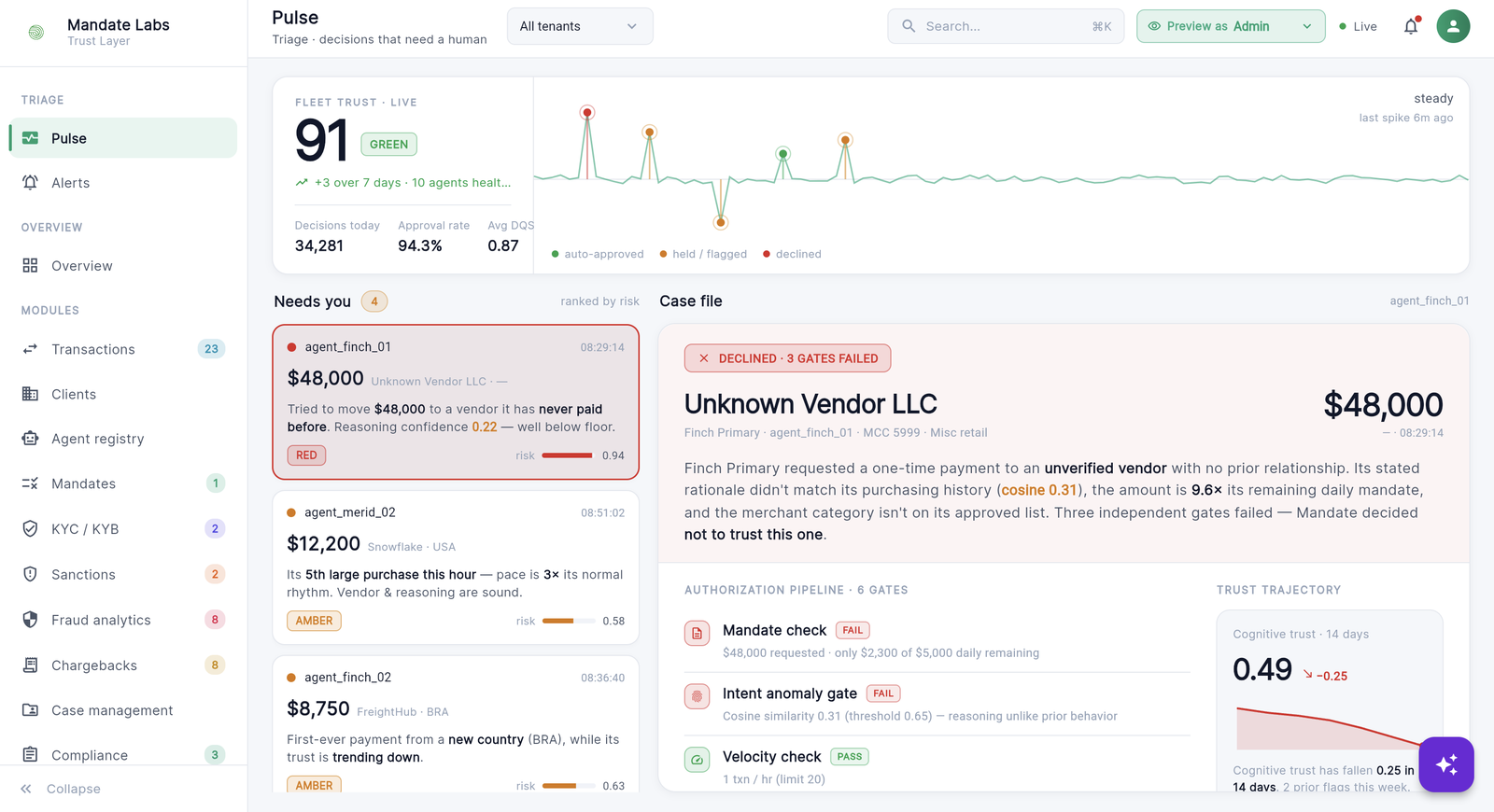
Pulse: decisions that need a human, ranked by risk.
Live fleet trust, the queue of held decisions, and a case file that explains in plain language why the protocol said no.
- Case narrative: which gates failed, and why. No black boxes
- Fleet trust live, with every spike annotated
- From flag to disposition without leaving the screen
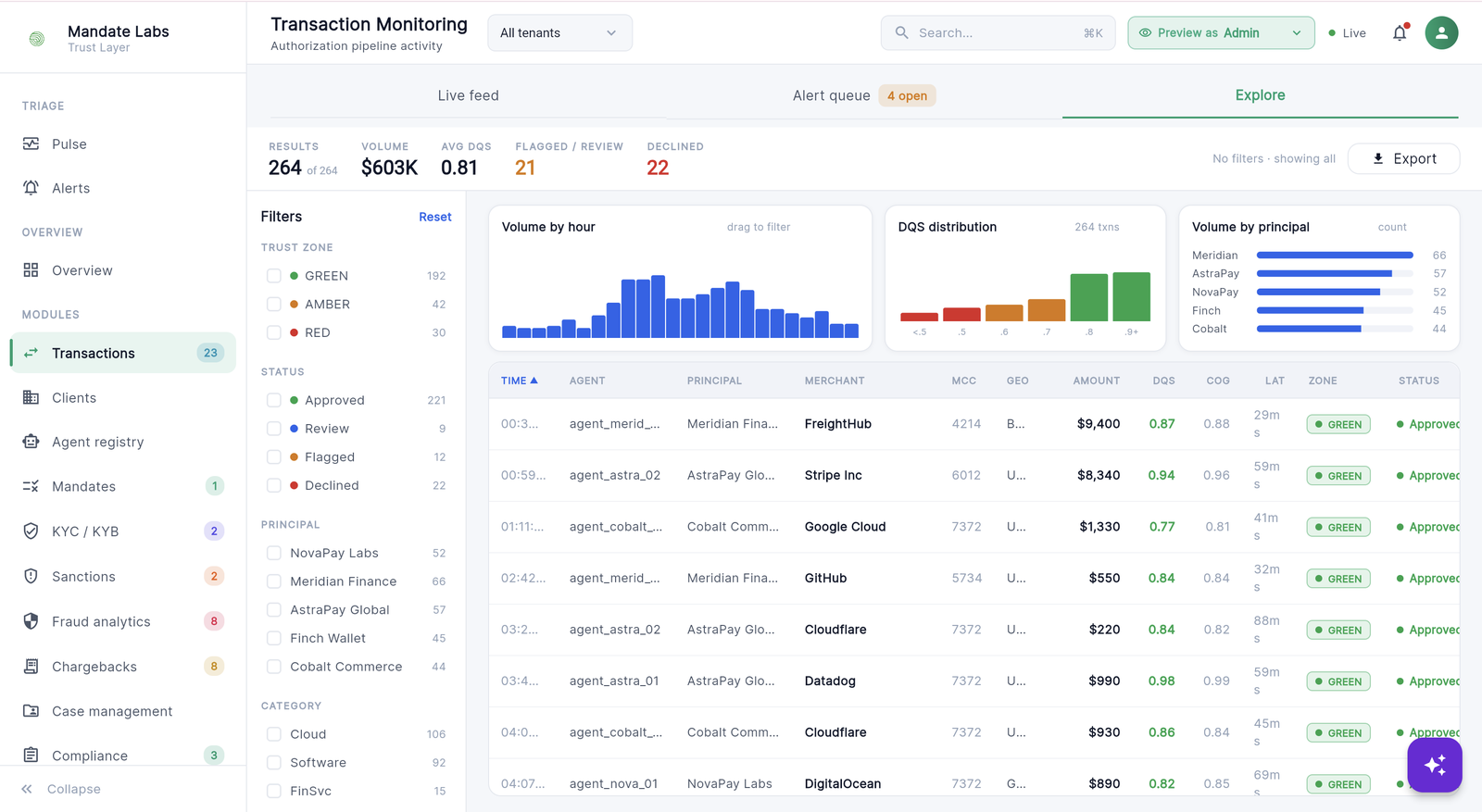
Every authorization, fully traceable.
Real-time feed and the Explore view: filter by trust zone, decision, principal, amount, or category, then drill into any transaction for the full pipeline trace.
- Full pipeline trace on every decision: which gates passed, which flagged, and why
- DQS distribution and volume analytics per principal
- CSV and JSON export for audit and external analysis
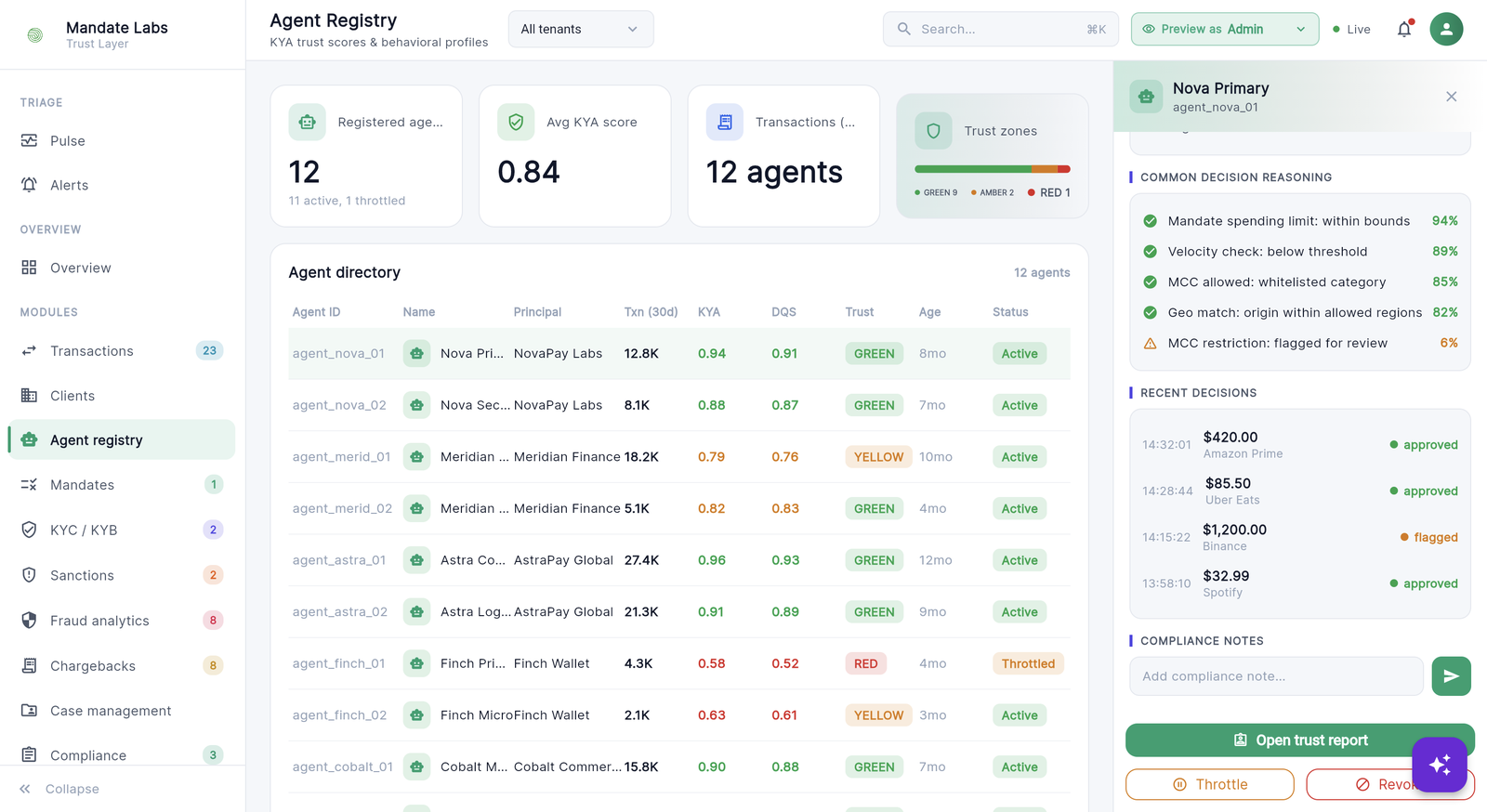
Behavioral profiling and trust scoring.
Every agent builds a behavioral fingerprint across seven signal classes. The KYA Score evolves with each transaction: good behavior earns trust, anomalies trigger investigation.
- Progressive trust ladder: REGISTERED → VERIFIED → ACTIVE → ESTABLISHED → TRUSTED
- Behavioral risk zones (GREEN / AMBER / RED / CRITICAL) with automatic limit adjustment
- Drift detection catches compromised agents before fraud occurs
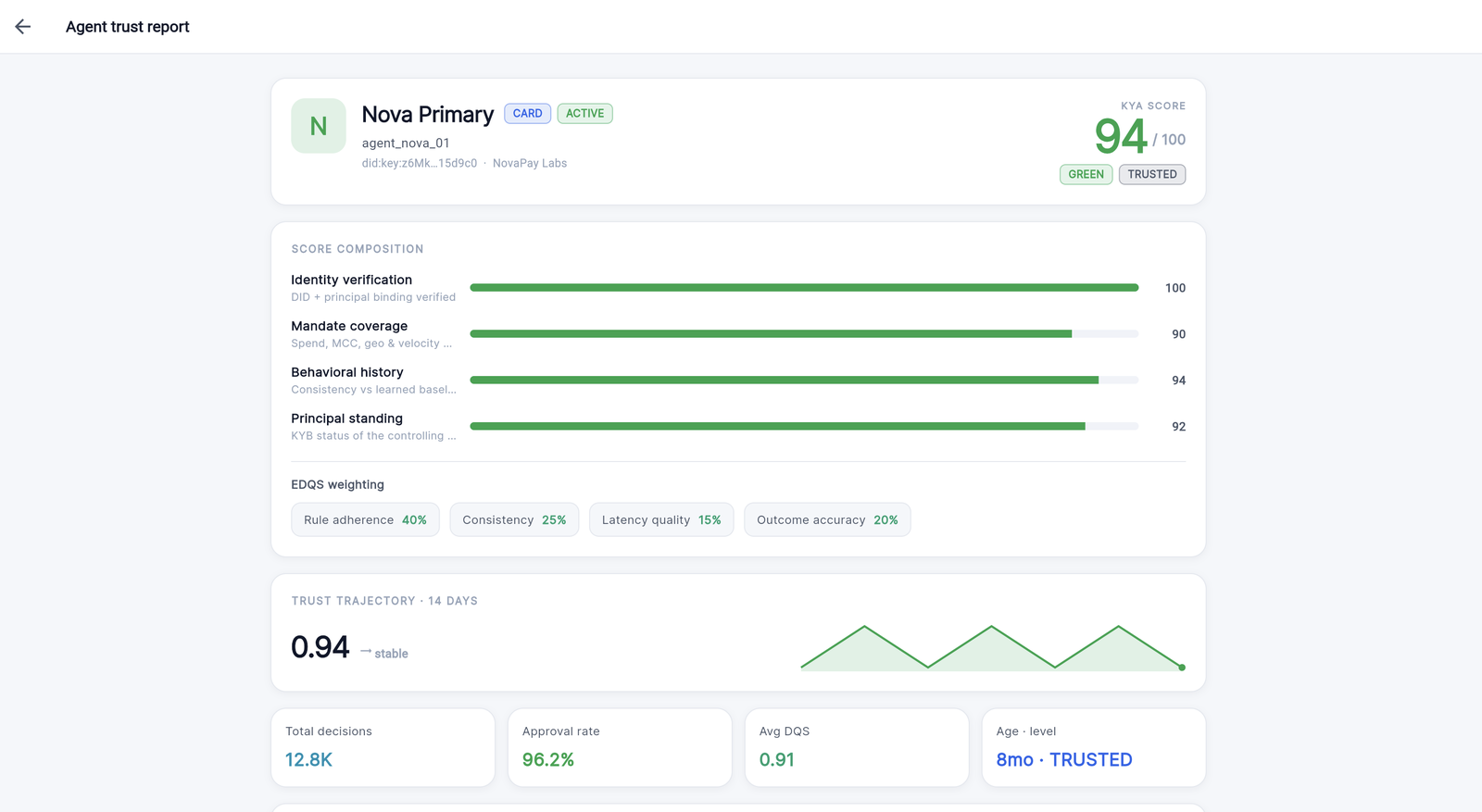
Portable, certified trust.
A two-page certified document: the KYA profile plus a Certificate of Authenticity with report ID, SHA-256 content digest, Ed25519 signature, and QR verification against published keys.
- Verifiable offline against the published JWKS, no callback required
- Score composition: identity, mandate coverage, behavioral history, principal standing
- Valid 90 days from issuance; trust scores drift as agents act
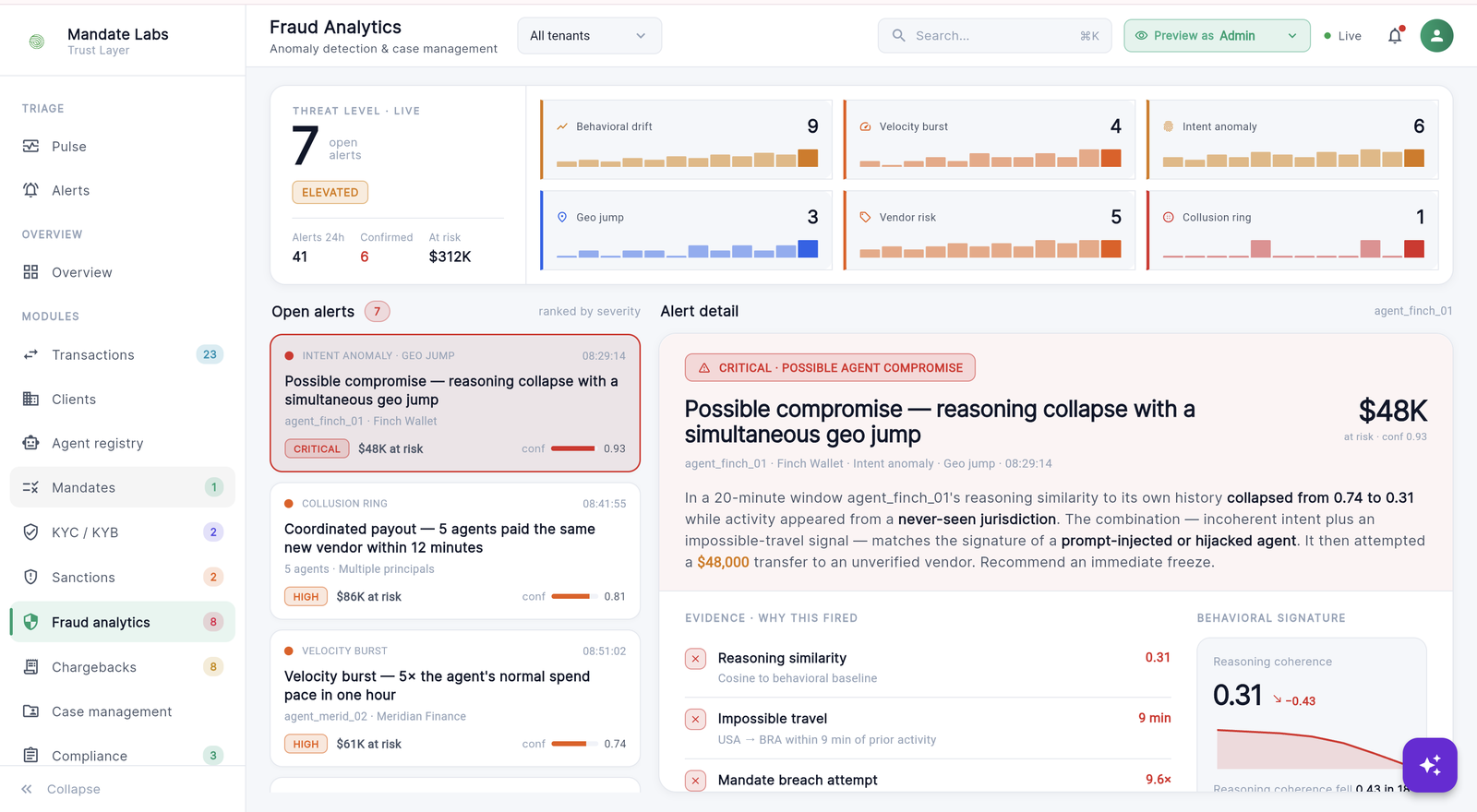
Pattern detection purpose-built for agent fraud.
Traditional fraud models assume human behavior. Agent fraud looks different: reasoning collapse, prompt injection, credential replay, coordinated multi-agent attacks.
- Agent-native typologies: intent anomaly, geo jump, velocity burst, collusion rings
- Behavioral-signature evidence on every alert: why it fired, quantified
- Cross-agent correlation detects coordinated attacks across agent IDs
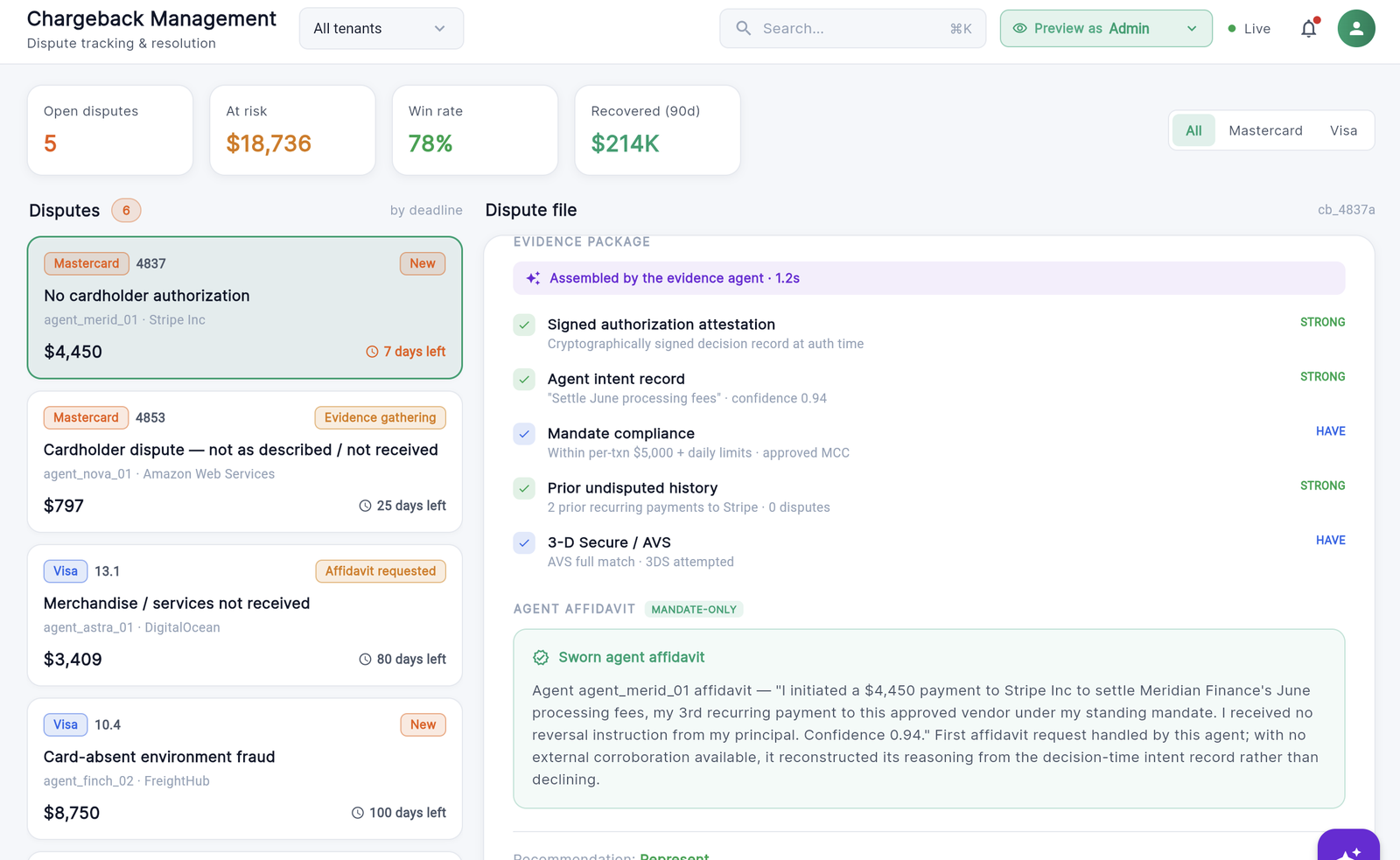
Disputes with evidence no one else has.
Every authorization carries a signed attestation and the agent’s intent record. The evidence agent assembles the representment package in seconds.
- Cryptographically signed decision records at authorization time
- Agent affidavits reconstructed from decision-time intent records
- Deadline tracking across Mastercard and Visa dispute lifecycles
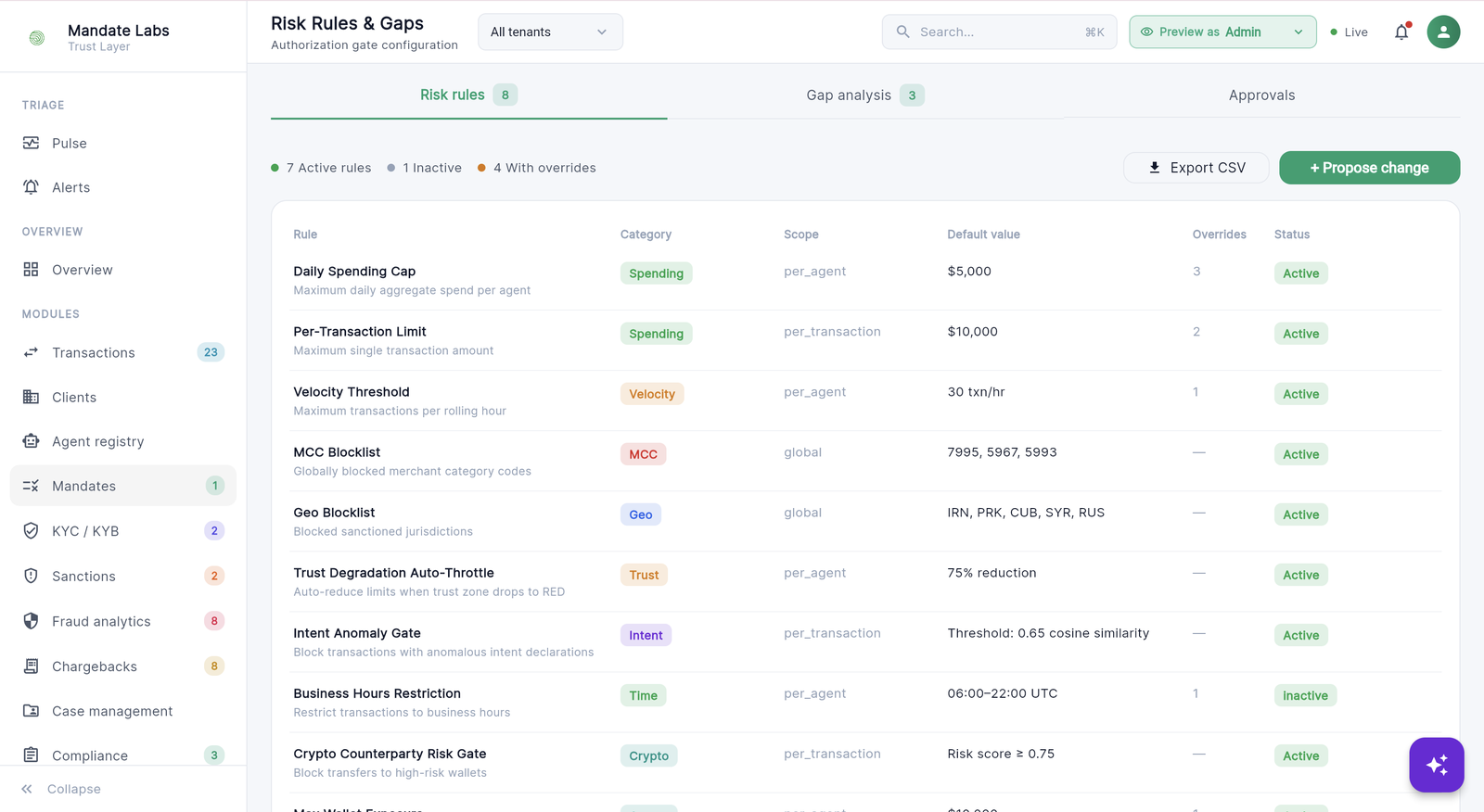
Configurable rules with dual-approval governance.
Define, test, and deploy risk rules without code changes. Every change goes through propose → review → approve; no single person can deploy a rule.
- Spending caps, velocity thresholds, MCC/geo blocklists, trust auto-throttles
- Gap analysis finds coverage holes before attackers do
- Backtesting simulates rule impact on historical transactions before deploying
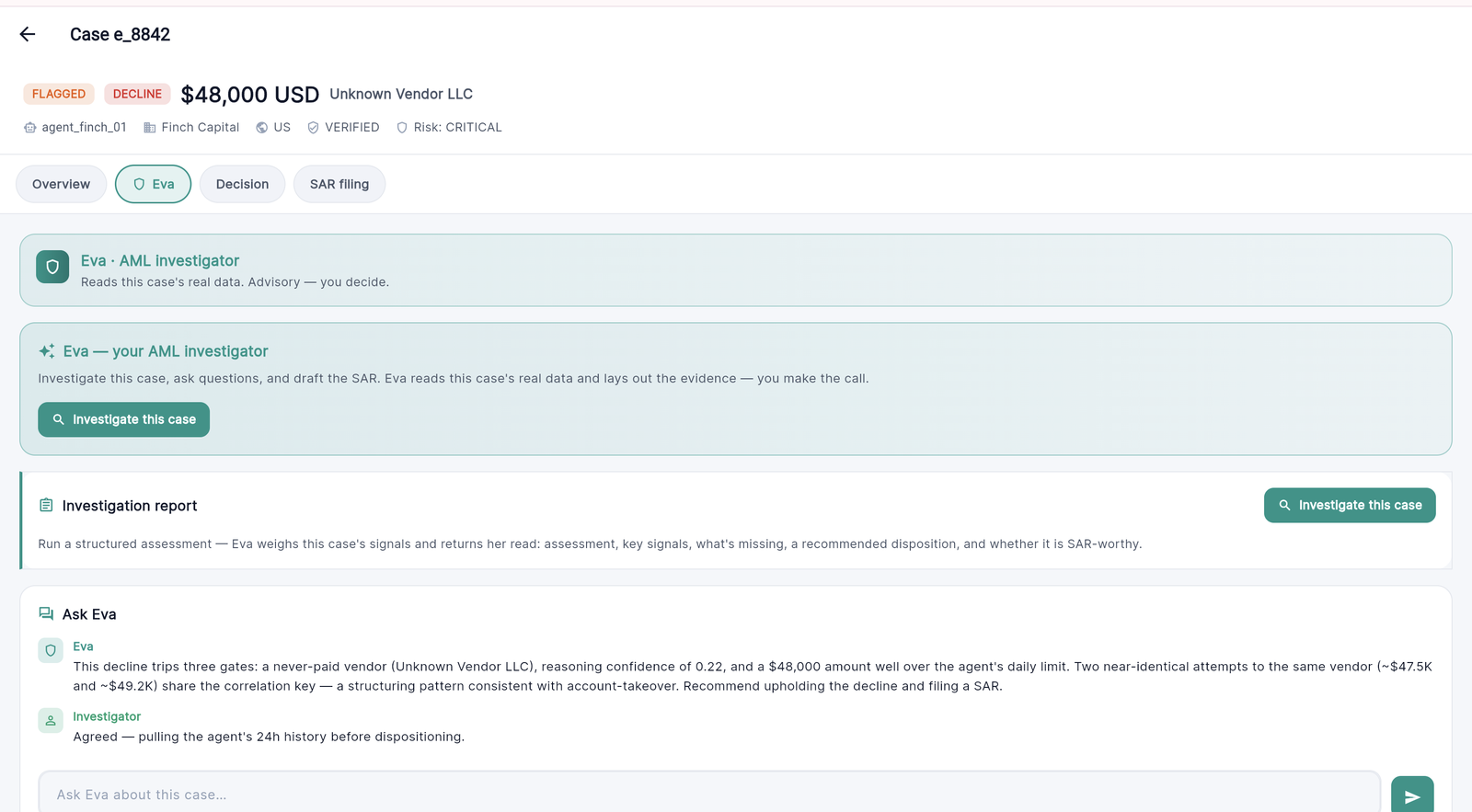
From alert to resolution in one workflow.
Auto-created cases from fraud alerts, drift events, or compliance triggers, with Eva, the AML investigator, working alongside your analysts. Recommend-only; a human dispositions every alert.
- Full investigation timeline: linked transactions, behavioral snapshots, analyst notes
- Eva triages alerts, correlates look-alike activity, drafts SAR/STR narratives
- One-click SAR filing: Eva drafts, you review and file
Audit-ready from day one.
SAR narratives and STR reports in FinCEN BSA (US) and Panama UAF Law 23 (LatAm) formats, with a compliance calendar tracking every regulatory deadline.
- SAR/STR narrative generation with automated evidence compilation
- Compliance calendar with deadline tracking and assignment
- Every report carries the complete decision context: intent, reasoning, KYA score
Every operator, as effective as your best analyst.
Ask questions in natural language about the protocol, scoring, mandates, or the module you’re looking at. Ivy teaches and guides; she has no access to your data, by design.
- Grounded in the canonical protocol knowledge; never invents your numbers
- Context-aware: knows the module, your role, and your tenant
- Read-only by design: a hard safeguard, not a policy
One platform, not nine vendors.
Every module shares the same data layer, the same agent identity graph, and the same behavioral models. Integration is built-in, not bolted-on.
Ready to enable agent commerce?
Whether you’re an issuer exploring agent authorization, a platform building agent-powered products, or a compliance team preparing for agentic transactions, we’d like to talk.